No Wi-Fi · No cell service · No tower
When the network dies, the crew doesn't.
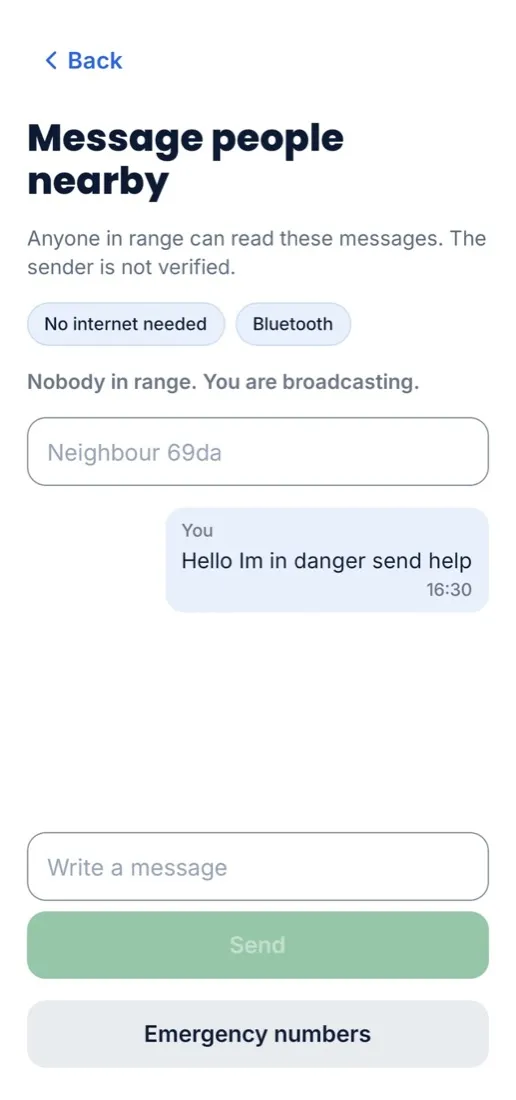
CrewOK keeps people reachable in the first hours after an earthquake — over Bluetooth mesh, with no tower and no internet.
The window in which most survivors are pulled out alive.
Bars of signal needed. The mesh runs entirely device-to-device.
Of live rescues in the 1999 Marmara earthquake were done by neighbours.
01 — Mesh
No tower.
No internet.
Still connected.
Phones in range find each other over Bluetooth LE and pass messages along, hop by hop. No account, no server, no infrastructure. When the cell network is gone, the crowd becomes the network.
02 — Check-in
One tap.
Family knows.
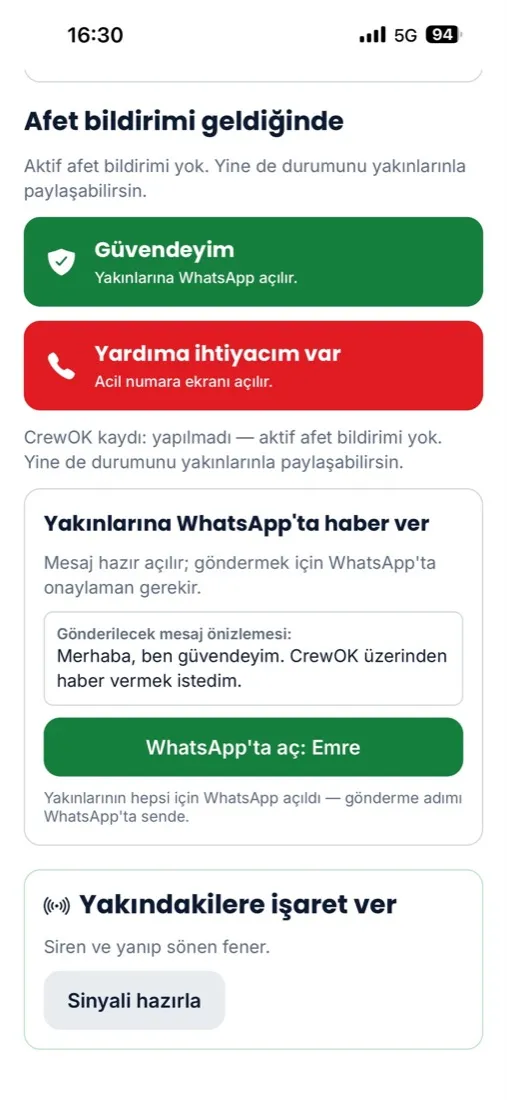
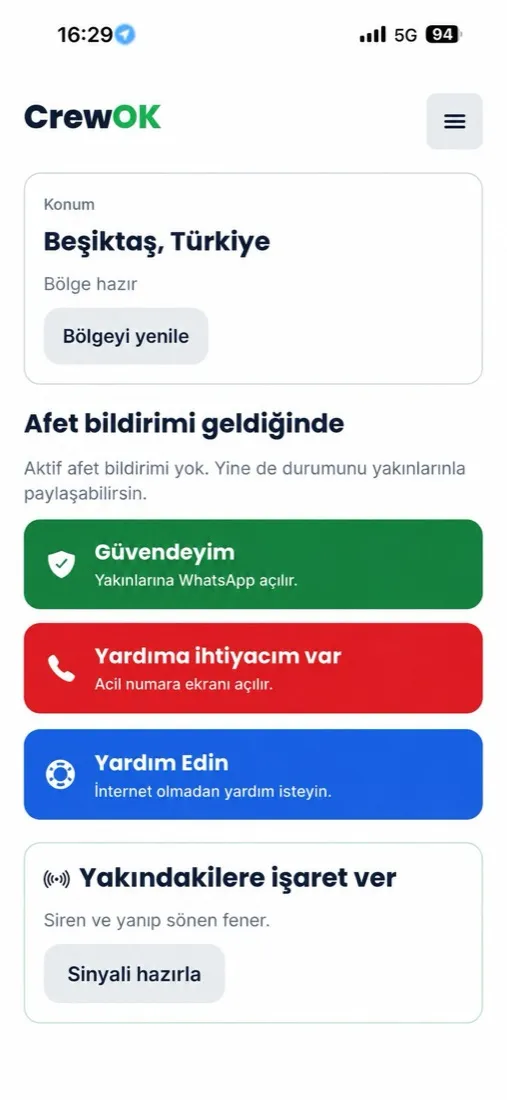
"I'm safe" opens a pre-written WhatsApp message to every person on your crew list. You still press send — CrewOK never speaks for you, and it never sends anything on your behalf.
03 — Beacon
Be heard
under the rubble.
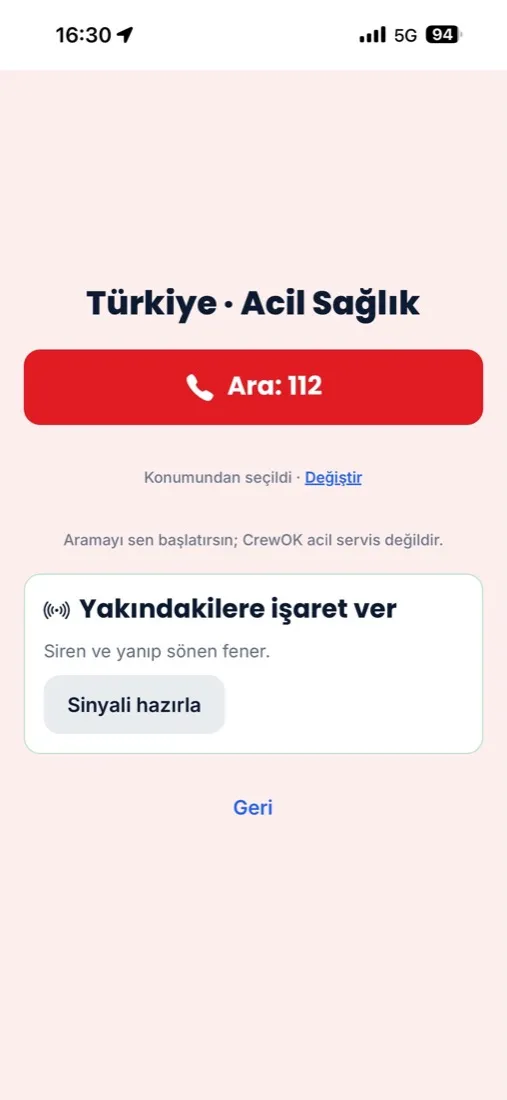
A siren and a strobe turn a trapped phone into a signal a search-and-rescue team can find, with the torch capped at 2 Hz for epilepsy safety. The right emergency number is resolved offline from a verified country table — and if a country isn't verified, CrewOK says so instead of guessing.
Three moves in the first ten minutes.
Talk without a network
Broadcast to anyone nearby over the mesh — neighbours, rescuers, strangers on the same street.
Tell your people
One tap prepares "I'm safe" for your crew, so nobody drives into the disaster zone looking for you.
Make noise
Siren, strobe and the local emergency line — everything a rescue team needs to locate you.
How it's built.
Privacy here isn't a policy document bolted on afterwards — it's the reason several database columns don't exist. Raw coordinates are never stored: the device quantizes its position to a roughly 5.5 km grid cell before anything leaves it, and fine location is blocked at the OS permission level. Trusted contacts never leave the device at all.
The offline paths — mesh, the beacon and the emergency number — are deliberately reachable without a session, because a life-safety screen that needs a login is a life-safety screen that fails.
- Client
- React Native, Expo SDK 54, expo-router, TypeScript
- Mesh
- Bluetooth LE, peer-to-peer relay, no server in the path
- Backend
- Supabase — Postgres, row-level security, Deno edge functions, pg_cron (EU/Frankfurt)
- Alerts
- USGS events, M4.5+, magnitude-scaled radius, 30-hour event TTL
- Emergency data
- 45 countries, every number carrying a source URL, access date and confidence class
- Status
- v1 feature-complete, prepared for App Store submission
- Built for
- Deprem Impact Lab — QNBEYOND, 2026
The team.
Muhammad Shayan Usman
Yunus Emre Aysel
Arda Arslan